Seabirds named George and Geraldine returned for their 10th anniversary as a coupleRodielon Putol Thu, November 26, 2026 at 12:07 PM UTC
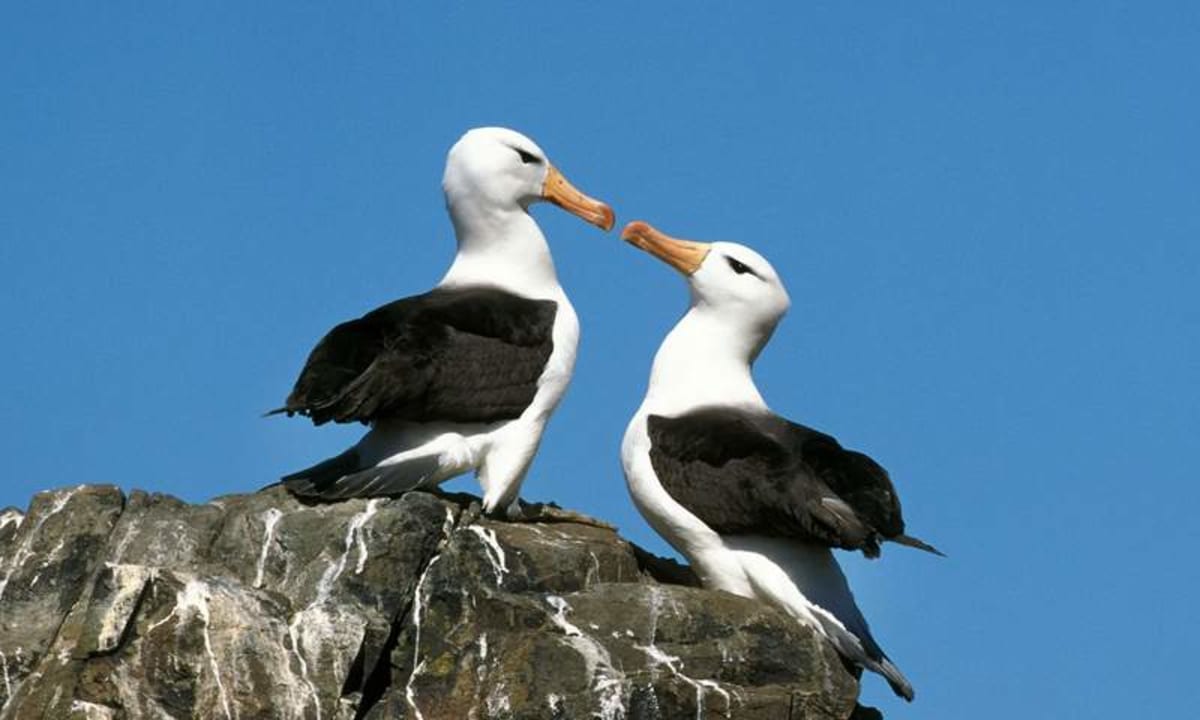
Two albatrosses perched on rocks. Credit: _slowmotiongli
Two short-tailed albatrosses known as George and Geraldine are back on Sand Island at Midway Atoll, which lies in the North Pacific.
Their arrival was confirmed in late October 2026, marking the 10th straight year the two have returned as a pair, according to the Agreement on the Conservation of Albatrosses and Petrels (ACAP).
ACAP describes them as the only short-tailed albatrosses breeding in the Northwestern Hawaiian Islands. Together they have raised and fledged at least five chicks.
Two birds from Torishima
Both birds were banded as chicks on Japan’s Torishima island. George hatched there in 2003 and has visited Midway since November 2006, when he was known as “Lonesome George.”
Geraldine is thought to be a bird banded on Torishima in April 2008. She was first seen on Midway in early 2012, ACAP reported in 2024.
The two were first seen together in late 2016 and first shared a nest the following season.
That 2017/18 season, they incubated an egg laid by a black-footed albatross, and the chick fledged. Black-footed and Laysan albatrosses also nest on Sand Island.
Geraldine’s sex was still listed as unconfirmed in 2018. She settled the question by laying the egg the two incubated in October 2023.
The first chicks on Sand Island
Before them, another short-tailed pair raised chicks on Midway’s Eastern Island, most recently in 2013/14. Its male was found dead there in November 2014.
George and Geraldine’s own first chick hatched on Jan. 3, 2019, and biologists banded it that May. It left its nest site earlier than expected, in late May, and became the first chick known to fledge from Sand Island.
Short-tailed albatross chicks hatch from late December through January, and each breeding cycle lasts about eight months.
Their next chick left in 2020. It walked across Sand Island before taking off over the water, likely to spend five or more years at sea.
“Nature has a way of reminding us that species and populations often have a remarkable capacity for resilience and fuel our hopes for recovering natural systems,” said Jonathan Plissner, then an island restoration specialist at Island Conservation, in 2020.
Young birds coming back
Not every season has worked. The 2021/22 egg did not hatch.
A chick that fledged in 2022/23 returned in April 2024 and displayed with one hatched in 2019/20. That November, two of their earlier chicks were photographed within a few feet of Geraldine as she incubated.
In late 2024, a fifth short-tailed albatross was also on Sand Island. The sub-adult, nicknamed Forest Bird, came from the same Torishima cohort as Geraldine and lived alone about a mile (1.6 kilometers) from the others.
George and Geraldine had no success in 2024/25. They bred again in 2025/26, when eight different short-tailed albatrosses were recorded on the atoll, three of them their offspring.
Those returning young birds may eventually start breeding on Midway themselves.
A species back from the brink
In Hawaiian, the short-tailed albatross is called makalena. Around the turn of the 20th century, feather hunters killed millions of them, nearly wiping out the species, according to the U.S. Fish and Wildlife Service (USFWS).
The agency listed the species as endangered throughout its range in 2000. A 2020 review estimated the population at 7,365 birds, growing about 8.9 percent a year.
It is the largest albatross in the North Pacific, with wings spanning about 7 to 7.5 feet (213 to 229 centimeters).
Short-tailed albatrosses begin breeding at five or six years old. Parents take turns on the egg and alternate foraging trips that can last two to three weeks.
Torishima, the main colony, is an active volcano. In 2010, a landslide there buried up to ten chicks.
Between 2008 and 2012, chicks moved from Torishima to Mukojima started a third colony.
Dangers at sea and on land
These albatrosses spend most of their lives at sea, ranging from China and Japan to Russia, Alaska and Canada. The highest concentrations occur around the Aleutian Islands and in the Bering Sea.
Birds that follow fishing boats can be hooked or tangled in longline gear and drown. Albatross chicks can also choke and die after eating plastic.
On land, Midway brings its own threat. Mice were first seen attacking albatrosses on the atoll in December 2015.
The Midway Seabird Protection Project spread bait across Sand Island by helicopter on July 20 and 21, 2023. Crews also scattered bait by hand in sensitive areas and used bait boxes around buildings.
By Aug. 15, mice were still being found, and eradication efforts were stopped.
The project then moved into what the USFWS calls a “Mitigation and Learning Phase.” A similar attempt on Gough Island also failed to remove mice that attack albatrosses and other seabirds.
The information was obtained from the Agreement on the Conservation of Albatrosses and Petrels.
—–
Like what you read? Subscribe to our newsletter for engaging articles, exclusive content, and the latest updates.
Check us out on EarthSnap, a free app brought to you by Eric Ralls and Earth.com.
—–
Source: Nature
